


 Ahonui Stanford Damar July 10, 2026 8:55 pm . 5 min read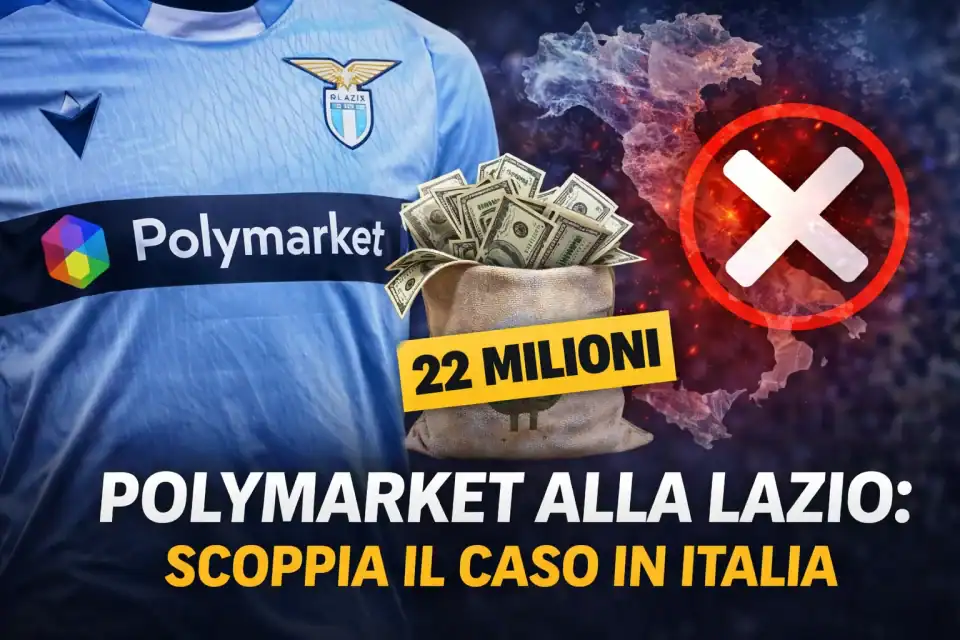
FolioPitch.com – 10 July 2026 | In a stunning development, Lazio have been hit with another significant setback as their main sponsor, Polymarket, has been blacklisted by Italian authorities. This New Blow for Lazio as Polymarket Get Blacklisted in Italy threatens not only the club’s lucrative sponsorship agreement but also adds to the mounting financial pressures facing president Claudio Lotito‘s administration. The two-year contract, signed in April after the Biancocelesti had gone nearly three seasons without a front-of-shirt sponsor, was expected to inject €22 million into the club’s coffers. However, with Polymarket now banned from operating in Italy, the future of that deal hangs in the balance.
According to multiple reports from Italian media outlets, including Il Corriere dello Sport and Calcio e Finanza, Polymarket’s website has been blocked after being placed on a government blacklist for conducting unauthorized gaming activities. Italian regulations require any platform offering betting or prediction-based services to obtain a license from the Agenzia delle Dogane e dei Monopoli (ADM). Polymarket, a New York-based company that operates a prediction market allowing users to bet on the outcome of future events by buying and selling odds, had previously been banned in 2025. At that time, they successfully challenged the ban at the Administrative Tribunal of Lazio, which suspended the order pending a final ruling. But now, while the court has yet to deliver its verdict, a new ban has been imposed, directly impacting Lazio’s sponsorship.
The New Blow for Lazio as Polymarket Get Blacklisted in Italy is particularly painful because the club had finally secured a stable sponsorship deal after years of searching. The agreement, which runs until 2028, was seen as a major win for Lotito’s regime, providing both financial stability and global exposure through a high-profile tech company. Now, with Polymarket deemed an illegal operator in Italy, Lazio may be prohibited from displaying the company’s logo on their jerseys, a requirement for any sponsorship to be valid. This could force the club to either renegotiate the contract terms, seek a temporary suspension, or even terminate the deal altogether.
Polymarket, for its part, maintains that its operations are distinct from traditional betting platforms. The company describes itself as a prediction market, arguing that users are trading on the likelihood of events rather than engaging in gambling under Italian law. This hybrid nature—somewhere between betting and financial trading—has been the crux of their legal defense. They contend that their services fall outside the scope of Italy’s gambling regulations and should be treated as a form of information aggregation. However, Italian authorities have consistently disagreed, leading to the current blacklisting. Whether Polymarket can once again secure a suspension of the ban remains to be seen, but for now, Lazio must prepare for the possibility that their sponsor might be unavailable for the upcoming season.
The implications for Lazio extend beyond the sponsorship itself. The club is already grappling with a financial crisis exacerbated by a fan boycott. Supporters have refused to attend matches and purchase season tickets in protest against Lotito’s management, a protest that could cost the club up to €20 million in lost revenue. The New Blow for Lazio as Polymarket Get Blacklisted in Italy adds another layer of uncertainty, potentially reducing the club’s income further and complicating their ability to compete in Serie A. Lotito’s regime, which has faced criticism for its lack of investment and communication with fans, now must navigate a sponsorship debacle that could make a difficult situation even worse.
What are Lazio’s options? The club could attempt to negotiate with Polymarket to find a workaround, perhaps by having the sponsor’s logo displayed only on non-playing apparel or during matches outside Italy. However, such measures might not satisfy either the authorities or Polymarket’s marketing goals. Alternatively, Lazio could terminate the contract prematurely, citing force majeure or regulatory breaches, and search for a new main sponsor. But finding a replacement willing to pay a similar amount on short notice is unlikely, especially given the club’s current financial turmoil. Some analysts suggest that a temporary patch solution might involve using a secondary sponsor, such as the club’s sleeve sponsor, to fill the void until the legal situation resolves.
This New Blow for Lazio as Polymarket Get Blacklisted in Italy also raises questions about the regulatory environment for prediction markets and crypto-related sponsors in Italian football. As more clubs sign deals with innovative tech firms, the clash between innovation and regulation becomes increasingly apparent. For Lazio, the timing could not be worse. With the Serie A season approaching, the club not only faces uncertainty on the pitch but also off it. The blacklisting of Polymarket is yet another hurdle that Lotito must overcome, but given the financial constraints and fan discontent, it may prove to be a turning point for the club’s direction.
In conclusion, the New Blow for Lazio as Polymarket Get Blacklisted in Italy represents a critical moment for the Biancocelesti. The partnership with Polymarket was seen as a step forward, but now it has become a liability. Lazio must act swiftly to resolve this issue, whether through legal challenges, contract renegotiations, or finding an alternative sponsor. Failure to do so could deepen the club’s financial crisis and further alienate an already disgruntled fan base. The coming weeks will be crucial in determining how Lazio navigates this latest obstacle in their quest for stability.
Ahonui Stanford Damar somehow turned a literature degree into a career writing news—maybe because fiction and breaking news both require a healthy dose of imagination. Based in Tangerang since 2011, he balances his journalistic cyn


This website uses cookies to ensure you get the best experience on our website and to comply with privacy regulations (GDPR). By continuing, you agree to our Privacy Policy and Cookie Policy.