

 Ahonui Stanford Damar October 28, 2026 12:53 am . 6 min read
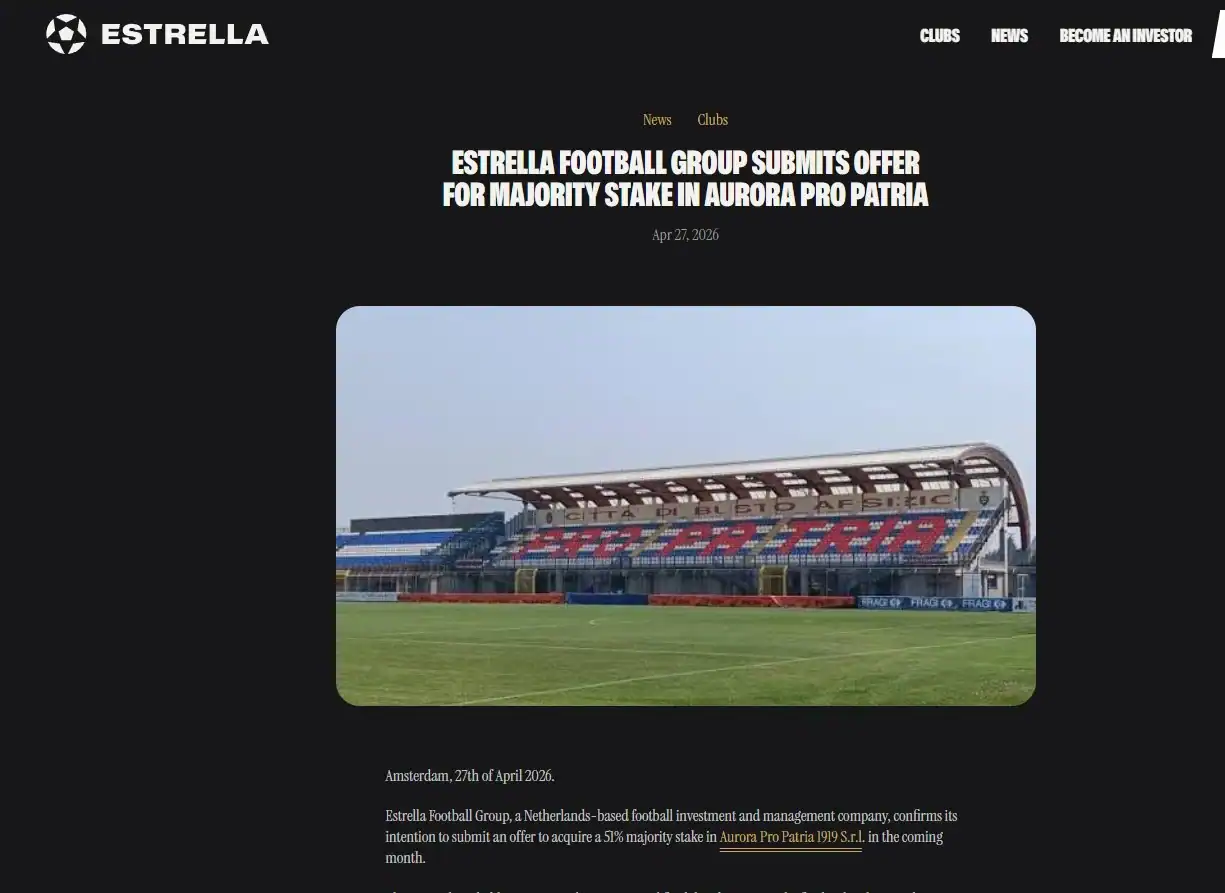
FolioPitch.com – 28 October 2026 | In an exclusive interview with Football Italia, Estrella Football Group co-founder and President David Dwinger unveiled the vision behind the group’s latest acquisition, Pro Patria, and explained how the ‘Exclusive From Pro Patria to the World Estrella s new model for running football clubs’ represents a fresh approach to multi-club ownership. The Italian Serie D club, based in Busto Arsizio, Lombardy, became Estrella’s third acquisition in July, following Portuguese sides Cascais SAD and Carvoeiro United. But unlike traditional multi-club models that impose a rigid hierarchy, Estrella’s horizontal structure allows each club to remain independent while benefiting from shared knowledge, operational resources, and long-term planning.
Dwinger, who comes from a family of Dutch champions and Olympians, is no stranger to the dedication required for elite performance. With a background in sport tech companies, he and his team have been searching for the next standard in football club ownership since acquiring Cascais in 2024. “In digital worlds everything is scalable. You just add more servers, and you can scale to the next 100,000 customers. In football, that’s different,” he says. When Estrella announced it was looking to buy another club, about 100 signed up, prompting the group to develop a rigorous 45-criteria evaluation tool. Today, their proprietary platform holds data on over 3,000 clubs, predominantly from Europe, with a strong focus on football-heavy nations like Italy.
The ‘Exclusive From Pro Patria to the World Estrella s new model for running football clubs’ is built on four macro-areas that define the types of clubs Estrella targets: Brand clubs, where location is paramount; Academy clubs, renowned for their youth development; Performance clubs, with the potential to compete at a professional level; and Fallen Angels, historically big clubs that have struggled in recent years. Pro Patria, according to Dwinger, sits between a performance club and an academy club. “I really liked the history as well as the close proximity to Milan. There’s, of course, a lot of football going on there,” he explains. “It should be a Serie C club, of course. And we see the potential to bring it at least to Serie B. Probably not in the next two years. But it has that potential.”
A key feature of Estrella’s approach is the balance between collective support and local autonomy. Clubs within the group share resources and best practices, but locally they continue to develop their own sporting project, maintaining strong connections with supporters and communities. “I feel that the academy is the base of a club. So, I think we need to have a strong academy with the potential to make these guys really become pro players,” Dwinger says. “My son used to play at the Ajax academy and for me, that’s the starting point. A club needs a strong academy to grow. Not every player will make it to the first team, but my ambition, and Estrella Football Club’s, should be to achieve the highest growth from the academy to the first team.”
Investing in Italian football presents unique challenges and opportunities. Dwinger sees a high percentage of Fallen Angels in Italy, perhaps more than in the Netherlands or Spain. “What I would really like to ensure is that clubs like Pro Patria, especially now that we’re involved, become really stable and not opportunistic,” he says. “There’s a lot of culture, a lot of emotion. So we should build it up even more, right? Imagine showing movies on the pitch, like an open-air cinema, and that movie night also gives you a free ticket to the next match. Or organising gala dinners at the stadium. And we can build content around that, and that content allows us to attract more eyeballs and get people to buy shirts in countries which are maybe even close to Italy.”
To facilitate knowledge sharing and operational efficiency, Estrella has developed ClubOS, an operating system for football clubs that sits in every department. “We’ve built an application called ClubOS. It’s an operating system for a football club,” Dwinger says. “It sits in every department, which we implement at all our clubs. External clients also use it. We’ve got a couple of pro clubs in the Netherlands using that tool, and we’re now rolling it out for Europe.” The group also organises training camps and staff exchanges, such as when Cascais staff visited Atletico Madrid for two days to work with their technical staff. “There’s a lot of knowledge per football club, which is within the walls of a football club and doesn’t really get out. We want to optimise that knowledge within our clubs, not just dictate from our side,” Dwinger adds.
Already, projects are taking shape involving Pro Patria. The group is in conversations with TenCate, a large Dutch company that creates pitches and has a plant in Italy, to potentially partner with Estrella so that all clubs can benefit from high-quality pitches. Similar partnerships exist for ticketing systems and GPS technology. “These are all partners for Estrella,” Dwinger notes. The core team remains deliberately small, comprising Dwinger, founding partner Alessandro Nuccetelli, co-founder and CEO Xander Czaikowski (former CEO of PEC Zwolle), and Global Sports Director Cristiano Piccini (former Italy international and Valencia defender). “We deliberately want to keep Estrella core team as small as possible. Because every euro I spend on a new guy is not going towards buying a football club,” Dwinger concludes.
Estrella’s goal is ambitious: to buy five clubs per year. “We believe that with our horizontal MCO, we’re the world’s first horizontal MCO, and that if we put the clubs next to each other, rather than stacking them on top of each other, this one becomes less important than the top one. We want to do it like this. That means that with every club we add, we add something else to the flywheel.” The ‘Exclusive From Pro Patria to the World Estrella s new model for running football clubs’ is not about splashing millions on new signings. “I don’t believe in it,” Dwinger says. “I want to build a system and a foundation which works to ensure that the club will be here for 100 more years. When we focus on the business side, it positively affects what’s happening on the field. I want to be promoted, but not just for the sake of promotion. I want promotion because we’ve done everything well. And that should result in promotion.”
In conclusion, Estrella Football Group’s innovative horizontal multi-club ownership model, exemplified by the ‘Exclusive From Pro Patria to the World Estrella s new model for running football clubs’, offers a sustainable and community-focused alternative to traditional football investment. By prioritising academies, local autonomy, and shared expertise, Estrella aims to build clubs that endure for generations, proving that success in football can be measured not just in trophies, but in the strength of foundations and the growth of young talent.
Ahonui Stanford Damar somehow turned a literature degree into a career writing news—maybe because fiction and breaking news both require a healthy dose of imagination. Based in Tangerang since 2011, he balances his journalistic cyn



This website uses cookies to ensure you get the best experience on our website and to comply with privacy regulations (GDPR). By continuing, you agree to our Privacy Policy and Cookie Policy.